


How on-chain targeting works, what it does better than cookies and IDFA, and what Web3 advertising results look like in practice.
For two decades, digital advertising ran on one trick where you drop a small file in someone’s browser, follow them around the web, and guess what they want. Cookies handled the desktop, and the IDFA handled the iPhone.
That machinery is wearing out, and in Web3 advertising a different identifier has taken its place: the wallet. This guide explains how wallet targeting (also called on-chain targeting) works, how it compares with cookies and IDFA, and what results advertisers are seeing.
Key takeaways
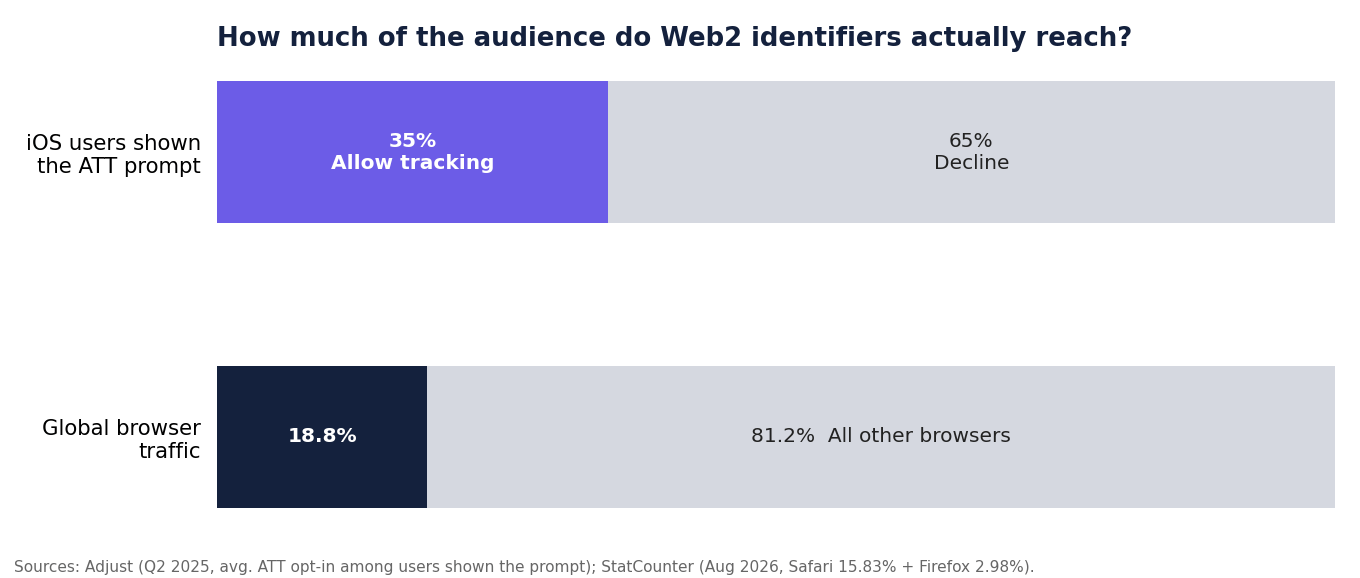
Chrome keeps third-party cookies, but Safari and Firefox (~19% of browser traffic) block them by default, and the Privacy Sandbox is gone.
On iOS, only ~35% of users shown Apple’s ATT prompt allow tracking.
Wallet targeting uses public on-chain data (transactions, holdings, protocol activity) to reach users based on what they do, not what an ad network guesses.
Slise campaigns report CTRs of 0.3% to 0.4%, versus an industry average of ~0.1%.
What is wallet targeting (on-chain targeting)?
Wallet targeting is an advertising method that selects an audience based on the public blockchain activity of crypto wallets, such as the tokens they hold, the protocols they use and the transactions they make. Unlike cookie-based targeting, it needs no browser tracking or personal data, because the signals come from public, pseudonymous on-chain records.
Are third-party cookies dead? What Chrome’s reversal means for advertisers
Let’s be precise, because this story is often told wrong. Google did not kill third-party cookies in Chrome. After years of delays, it announced in 2025 that it would keep its current approach and later retired the Privacy Sandbox, the set of APIs meant to replace cookies.
That sounds like good news for cookie-based targeting but it isn’t, for three reasons:
The web is fragmented: Safari and Firefox already block third-party cookies by default. Per StatCounter, they have ~19% of global browser traffic (15.83% and 2.98% in August 2026).
Consent is still required: Under laws like GDPR and ePrivacy, sites must still obtain user consent before using cookies for tracking.
The ground keeps moving: A tracking method that has been announced, delayed, reversed and abandoned within five years is a liability and does not looks like an infrastructure.
IDFA and ATT: why iOS tracking opt-in is only ~35%
On iOS, Apple’s App Tracking Transparency (ATT) prompt asks users whether an app may track them across other companies’ apps and sites. According to Adjust’s Q2 2025 benchmark, the industry-wide average opt-in rate is ~35%, and that’s among users who were actually shown the prompt. So ~65% of that audience is invisible to IDFA-based targeting, and the signal that remains describes a device, but not a person.
Wallet targeting vs. cookies vs. IDFA
A wallet address is a persistent identifier that the user controls, and it carries something cookies never had: a verifiable record of what that user has actually done with real money. Here is how the three identifiers compare:
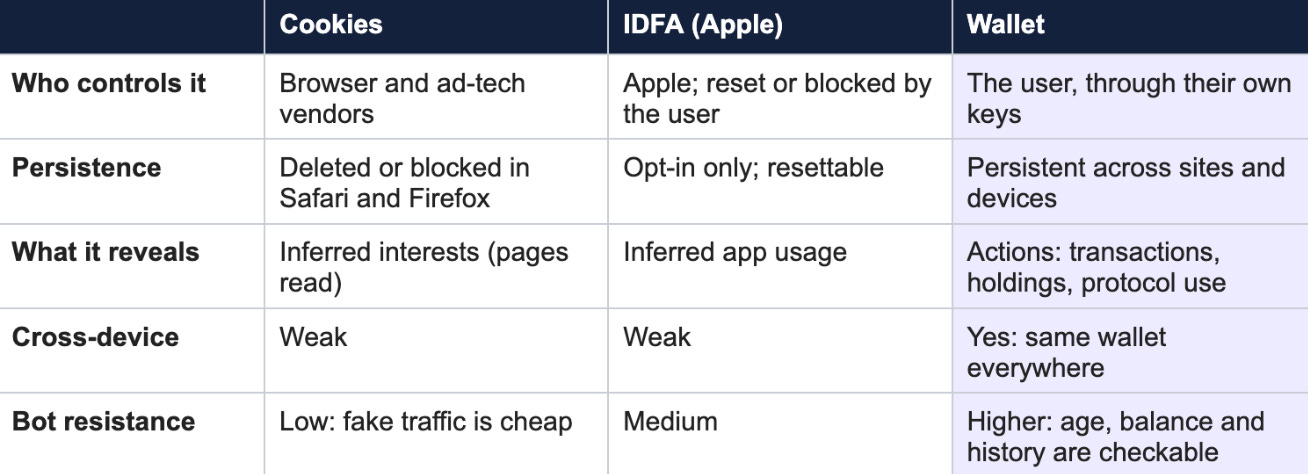
The key difference is inference versus evidence. A cookie suggests that someone read three articles about DeFi, a wallet shows that they bridged funds to a new chain last week, supplied liquidity yesterday, and have held the same governance token for a year.
On-chain targeting signals: transactions, holdings and protocol activity
Transactions: what they do. Example: wallets that swapped on a DEX in the last 30 days but have never used a lending protocol. For me it looks like a clean audience for a lending launch.
Holdings: what they have. Example: wallets holding ETH and stablecoins on mainnet that have never bridged to an L2. That’s a natural audience for a new rollup, or for a hardware wallet brand.
Protocol activity: how they behave. Example: wallets that interact with smart contracts on testnets are very likely developers. That’s the audience an infrastructure provider wants to reach.
These segments are illustrative, but the logic is real. You can also build lookalike audiences from your best existing users’ wallets and find more people who behave like them, a classic Web2 technique that works better when the seed data is behavioral rather than inferred.
Sky Mavis’ VP of Growth, Quinn Campbell, has said that on-chain targeting is more powerful than traditional Web2 targeting in a post-cookie world.
Web3 advertising results: on-chain targeting case studies
Here are results from real campaigns run through Slise, as published in its case studies:
QuickNode needed to reach Web3 developers, who are almost impossible to find on Web2 ad platforms. By serving ads on block explorers, including testnet explorers where developers test contracts, the campaign reached an average CTR of 0.46% at an average cost per click of $1.3. The industry average cited is ~0.1%.
COINSBEE wanted paying crypto-native users. The campaign reached a 0.58% CTR at a $1.15 CPC, with CPMs of $6–7.
Trezor vs. Ledger. Both hardware wallet makers targeted DeFi users, whales and NFT investors. More than 50 creatives were tested, with a 20x performance gap between the best and worst banners. Trezor’s campaign, built around seed-phrase ownership, showed a 1.5x higher CTR.
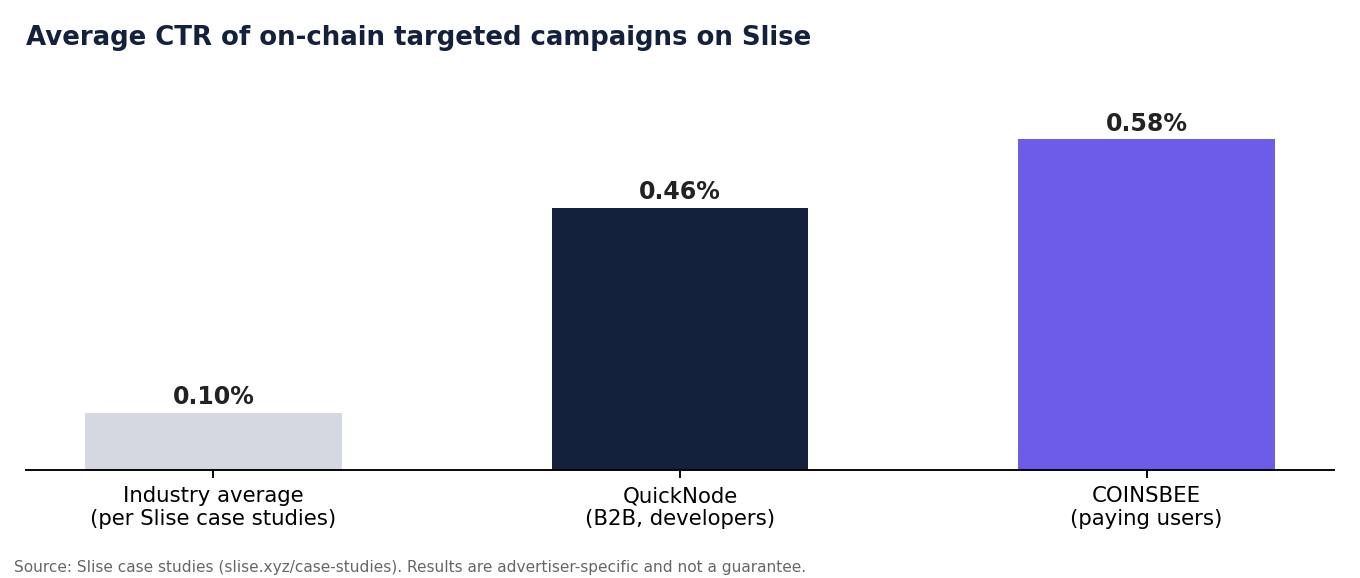
Note: these are advertiser-specific results reported by Slise, so your numbers will depend on the product, the offer and the creative.
Limits of wallet-based targeting
A good article should say what the wallet can’t do:
A wallet is not a person as one person can run many wallets, and one wallet can be a bot, a DAO or a farming script. Filters for wallet age, activity and balance matter as much as the segment itself.
It only works for crypto-native audiences. If your product targets people who have never touched a wallet, you still need other channels.
Privacy is a design choice. On-chain data is public, but a responsible platform uses it for segmenting audiences, not for identifying individuals.
How to start wallet targeting: 5 steps
Define the goal. Signups, wallet connects, swaps or paying users: pick one conversion event.
Choose a segment. Start from behavior, for example DEX users who have never used lending, or holders of a competitor’s token.
Filter for quality. Use wallet age, activity and balance to cut bots and farmers.
Test creatives. Run several banners per segment; in the Trezor and Ledger campaigns, the gap between best and worst creatives was 20x.
Measure on-chain. Track conversions and expand the segments that convert. For pricing logic, see Slise’s guide The Real Cost of Attention.
How Slise works
Slise is a Web3-native programmatic ad platform. Instead of following users around the web, it targets wallets using public blockchain data and serves ads where crypto users already spend their time.
Placement: ads run on a curated network of dApps and block explorers, the places where crypto-natives actually transact.
Targeting: pick Web3 personas, build lookalike audiences, or upload a list of target wallets.
Programmatic tooling: real-time analytics, A/B testing and automatic conversion tracking.
Privacy: only public blockchain data is used, with no dependence on third-party cookies in Chrome, Safari or Brave.
For publishers: dApps get a sustainable monetization channel that pays far more than typical Web2 ad networks.
Ready to try on-chain targeting?
Cookies gave marketers a guess. Wallets give them evidence. If you want to reach real crypto users with real intent, see the case studies, check the launch offer, or get in touch with the Slise team.